Recurring issues are rarely just support issues
Repeated issues are more than operational noise. They can reveal weaknesses in workflows, integrations, product behavior, ownership, or documentation.

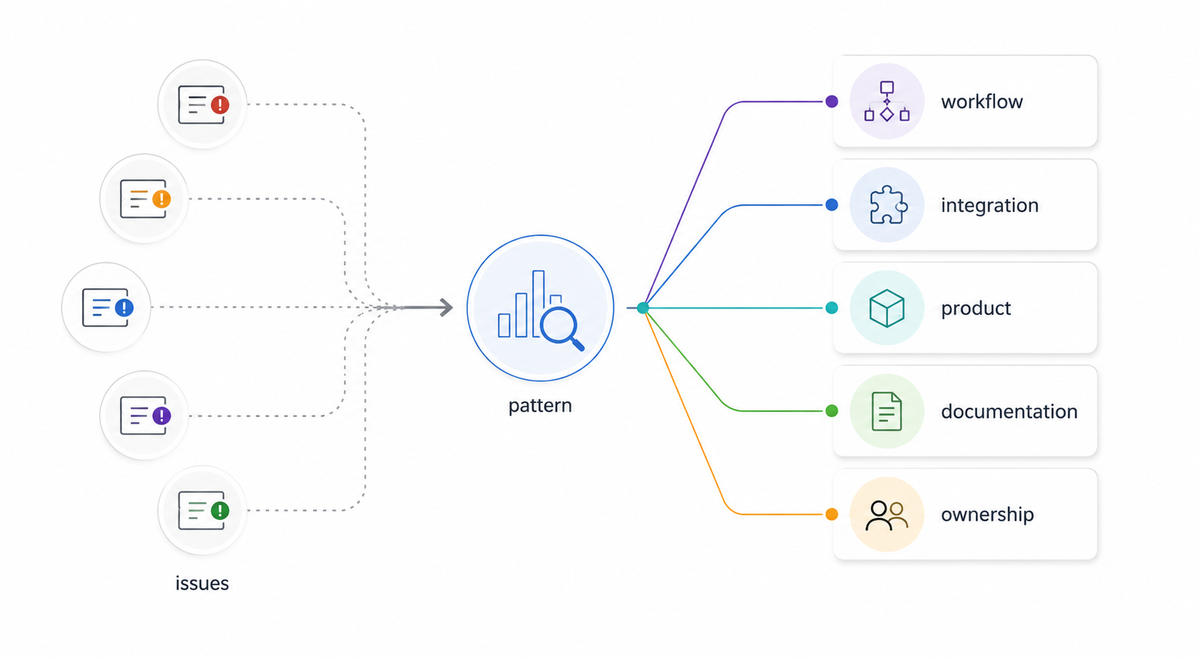
When the same issue appears several times, the immediate response is usually operational.
A user needs help.
A customer reports a problem.
A support ticket is created.
Someone investigates.
The issue is resolved.
That is necessary.
But if the same type of problem keeps coming back, resolving each individual case is no longer enough.
At that point, the question changes from:
How do we fix this case?
to:
Why does this keep happening?
Repetition is information
A single issue can be an exception.
Several similar issues are a pattern.
Patterns tell us something about the system, the workflow, the product, the documentation, or the way responsibilities are distributed.
The root cause may be technical.
But it may also be that:
A workflow is unclear.
A configuration is too easy to misunderstand.
A business rule is missing.
An integration behaves differently from what users expect.
Documentation assumes knowledge that users do not have.
Teams are solving the same problem manually because no one owns the underlying cause.
Recurring issues are therefore useful signals.
They show where reality differs from the assumptions made during design.
Solving the ticket is not the same as solving the problem
Support work is naturally focused on restoring normal operation.
That is often the right priority.
But the fastest way to resolve an individual case may not remove the reason why the issue happened.
A manual correction may fix the data.
A retry may complete the transaction.
A workaround may allow the user to continue.
An explanation may unblock the customer.
All of these can be good responses.
But if the same intervention is required repeatedly, the operational workaround itself becomes evidence.
The organization is paying a recurring cost somewhere.
Patterns need context
Counting incidents is useful, but frequency alone does not tell us what deserves attention.
An issue that happens rarely may have a very high customer impact.
A frequent issue may be easy to resolve and relatively harmless.
A technically small problem may consume a disproportionate amount of support time because it is difficult to diagnose.
A customer may repeatedly report something that looks like user error but actually exposes a confusing product behavior.
This is why recurring issues need context.
How often does it happen?
Who is affected?
How severe is the impact?
How much effort does it take to diagnose and resolve?
Is there a workaround?
Is the underlying cause understood?
Is the pattern becoming more frequent?
The goal is not to eliminate every recurring problem.
It is to decide which patterns matter.
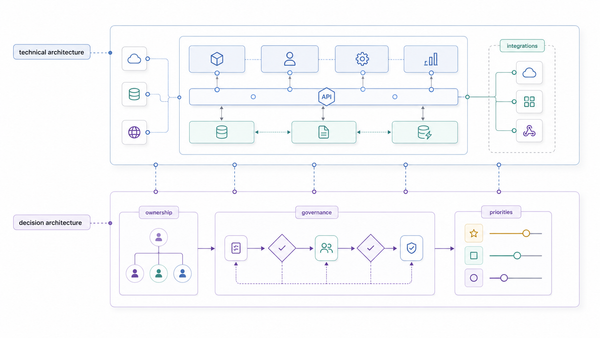
The answer may sit between teams
Recurring problems often cross organizational boundaries.
Support sees the tickets.
Technical teams see logs and errors.
Product teams understand intended behavior.
Customer-facing teams understand the business context.
Operations teams see the manual work created by the issue.
None of these perspectives is complete on its own.
A pattern that looks insignificant from one team may be obvious from another.
This is why the most useful question is sometimes not:
Who owns this problem?
but:
Who has the different pieces needed to understand it?
The answer may require several teams before ownership becomes clear.
Some issues should become improvements
Once a recurring pattern is understood, several responses are possible.
The product may need to change.
The integration may need stronger validation or better error handling.
The workflow may need to be simplified.
Documentation may need to explain an assumption more clearly.
Monitoring may need to detect the situation earlier.
A business process may need to change.
Or the team may decide that the current behavior is acceptable and simply make the response easier and faster.
The important thing is that the decision becomes deliberate.
Without that step, teams can spend months repeatedly resolving the same type of problem without ever deciding whether it should continue to exist.
Operations can improve design
Operational work is sometimes treated as something that happens after the interesting design work is finished.
In reality, operations provide some of the best evidence about how a solution behaves.
Recurring issues show where assumptions were wrong, where workflows are fragile, where users are confused, and where systems do not behave as expected.
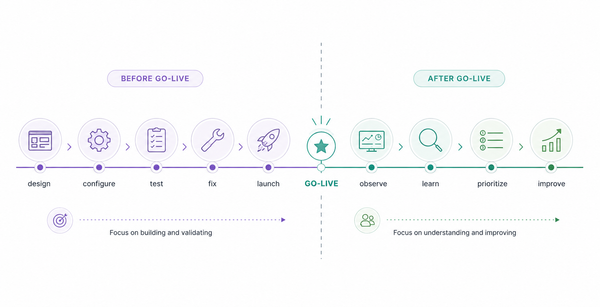
That information can feed back into product decisions, integration design, documentation, processes and prioritization.
The goal is not to turn every support issue into a project.
It is to notice when individual incidents stop being isolated events and start becoming a pattern worth understanding.
Because recurring issues are rarely just support issues.
They are information about how the system really works.