Why business and IT teams misunderstand each other
Business and IT teams often look at the same platform project through different lenses. Many misunderstandings come from hidden assumptions, unclear language, and conflicting operational realities.

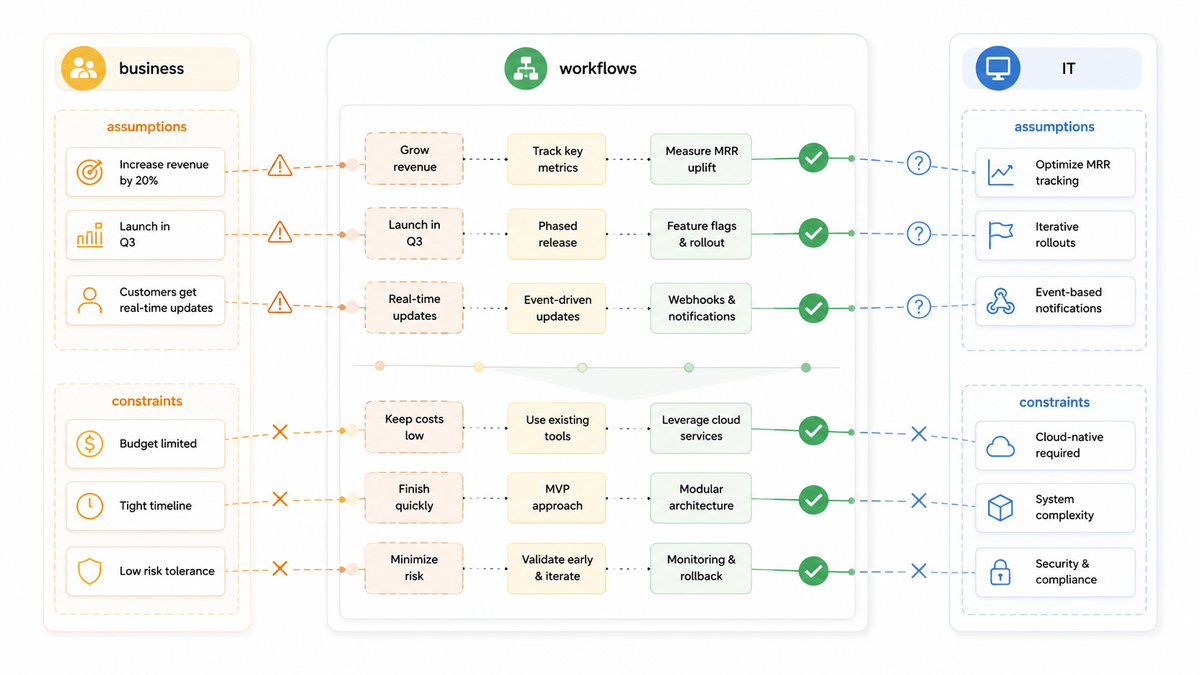
In many platform or integration projects, the biggest difficulties are not purely technical.
They often come from the way different teams see the same problem.
Business teams may feel that IT is slowing things down, focusing too much on constraints, or overcomplicating simple requests.
IT teams may feel that business expectations are unrealistic, unclear, constantly changing, or disconnected from operational reality.
Both perspectives can be understandable at the same time.
The problem is that the two sides are often looking at different parts of the system.
Business teams usually focus on outcomes
Business stakeholders are typically focused on goals, workflows, timelines, customers, and operational impact.
They want to know:
Can users do what they need to do?
Will this improve the workflow?
Can we launch on time?
Will reporting be available?
Can the process scale?
Will the experience feel simple?
From this perspective, technical discussions can sometimes feel disconnected from the real objective.
A business stakeholder may see a request as straightforward:
“We just need the systems to synchronize automatically.”
But behind that sentence, there may be many hidden technical questions:
Which system owns the data?
What happens if records conflict?
Should updates be real time?
How are failures detected?
Who maintains the integration?
What security rules apply?
The business request is valid. But the implementation reality may be more complex than it first appears.
IT teams usually focus on reliability and constraints
Technical teams often think in terms of systems, dependencies, maintainability, support, security, and operational risk.
They are responsible for making sure the platform can continue working after launch.
That changes the way they evaluate decisions.
A workflow that looks simple in a presentation may introduce:
- new integration dependencies
- unclear ownership
- support complexity
- security concerns
- reporting inconsistencies
- maintenance overhead
- long-term operational risk
From the IT perspective, saying “yes” too quickly can create problems that appear months later.
This does not mean technical teams are resistant to change.
It often means they are trying to protect the stability of a broader ecosystem that business teams may not fully see.
The same words can mean different things
Another common issue is language.
Teams often use the same terms while meaning different things.
For example:
“Automatic”
“Integrated”
“Real time”
“Flexible”
“Simple”
“Reporting”
“Admin access”
These words sound clear, but they can hide very different expectations.
For one person, “real time” means immediate synchronization.
For another, it means “without manual export”.
For another, it simply means “available the same day”.
Many misunderstandings start because teams assume a shared understanding that does not actually exist.
Technical decisions are often business decisions
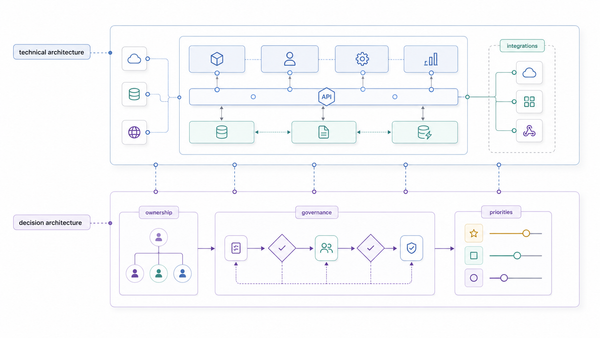
One reason these conversations become difficult is that many technical choices also affect operations, governance, workflows, and responsibilities.
A permission model affects organizational control.
An integration affects how teams collaborate.
A reporting structure affects decision-making.
A platform workflow affects how people work every day.
This is why platform projects often become cross-functional discussions rather than purely technical implementations.
The technology cannot really be separated from the organization around it.
The role of translation
One of the most useful things in these projects is often not deep technical expertise alone.
It is translation.
Helping business teams understand why a technical constraint matters.
Helping technical teams understand why a workflow detail matters.
Helping stakeholders see how decisions affect other parts of the system.
Helping teams move from isolated requests toward a shared understanding of the problem.
This kind of translation reduces friction long before implementation begins.
The goal is not perfect alignment
Business and IT teams will never see problems in exactly the same way, and they should not.
Different perspectives are useful.
The goal is not to eliminate disagreement.
The goal is to make assumptions visible early enough to have better conversations and make better decisions.
When projects fail, it is often not because one side was wrong.
It is because important assumptions stayed invisible for too long.
And that is usually where misunderstandings become implementation problems.