Good technical discovery is not a questionnaire
Technical discovery is not only about collecting answers. It is about reducing ambiguity, understanding workflows, exposing assumptions, and designing a solution that can work in practice.

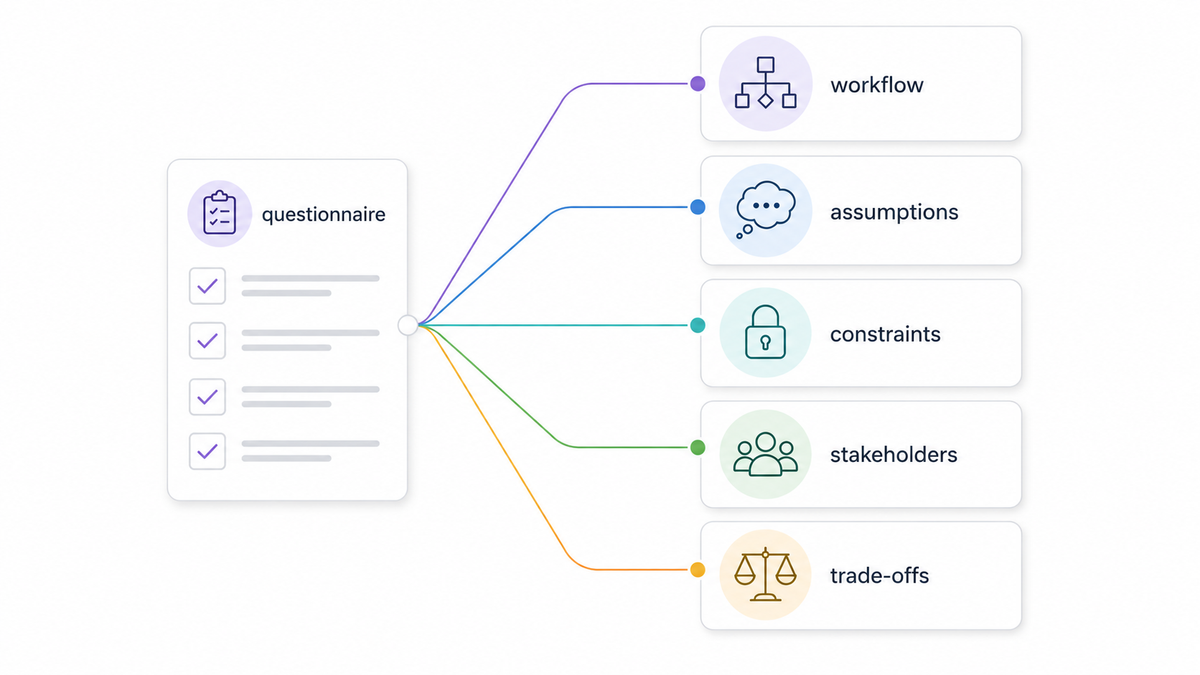
Technical discovery is often treated as a list of questions.
Which systems do you use?
Do you need an API?
Do you use SSO?
How many users do you have?
What data do you need to synchronize?
What reports do you need?
These questions are useful. But they are only the beginning.
Good technical discovery is not about collecting answers. It is about understanding how the organization really works, where the constraints are, and what needs to be true for a solution to succeed.
A questionnaire can tell you what a team says it needs.
A good discovery conversation helps you understand what is behind the need.
The first answer is rarely the full answer
When someone says they need an integration, it can mean many things.
They may need to avoid manual work.
They may need more reliable data.
They may need a better user experience.
They may need reporting.
They may need compliance.
They may need to connect two teams that currently work in silos.
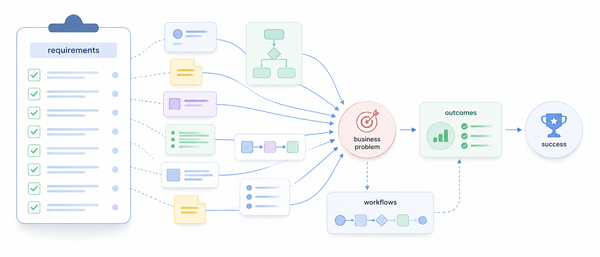
The technical request is often the visible part of a broader business problem.
This is why it is important to listen to the words being used, but also to understand the reason behind them.
If the conversation stops at “we need an API”, the real problem may remain unclear.
Discovery should reveal the workflow
Before discussing the solution, it helps to understand the current workflow.
Who starts the process?
What happens next?
Which systems are involved?
Where do people wait, check, correct, approve, or escalate?
What happens when there is an exception?
Which part of the process is painful today?
This matters because many technical decisions are really workflow decisions.
A platform configuration, an integration, a permission model, or a reporting setup only makes sense when the underlying workflow is clear.
Without that, teams risk designing for an ideal process that does not match reality.
Discovery should expose assumptions
Stakeholders often share requirements as if everyone has the same understanding.
But words like “automatic”, “real time”, “integrated”, “reporting”, “admin”, “user”, or “workflow” can mean different things to different teams.
For example, “real time” may mean instant synchronization for one person, hourly updates for another, and “without manual export” for someone else.
“Reporting” may mean dashboards, raw data exports, operational alerts, finance reconciliation, or executive summaries.
A good discovery conversation makes these assumptions visible before they become implementation problems.
Discovery should clarify constraints
A solution does not exist in a vacuum.
There may be security rules, legacy systems, data quality issues, team capacity limits, vendor constraints, budget limits, or operating model questions.
Ignoring these constraints does not make the project simpler. It only moves the complexity later.
Good technical discovery brings constraints into the conversation early enough to make better decisions.
That does not mean saying no too quickly. It means understanding what is realistic, what is risky, and what needs to be designed carefully.
Discovery is also communication
Technical discovery is not only about asking better questions.
It is also about helping different people understand each other.
Business teams may not see why a technical detail matters.
Technical teams may not see why a small workflow exception matters.
Product teams may focus on the standard product behavior.
Operations teams may worry about what happens after launch.
A good discovery conversation connects these perspectives.
It turns separate concerns into a shared picture of the problem.
The real purpose of discovery
The goal of technical discovery is not to fill a document.
It is to reduce ambiguity.
It should help teams understand:
What problem are we solving?
Which workflows are affected?
Which systems and data flows are involved?
What constraints matter?
What assumptions need to be tested?
What trade-offs need to be discussed?
What would make the solution workable in practice?
A questionnaire can collect information.
But good technical discovery creates understanding.
And that understanding is what allows better solution design.